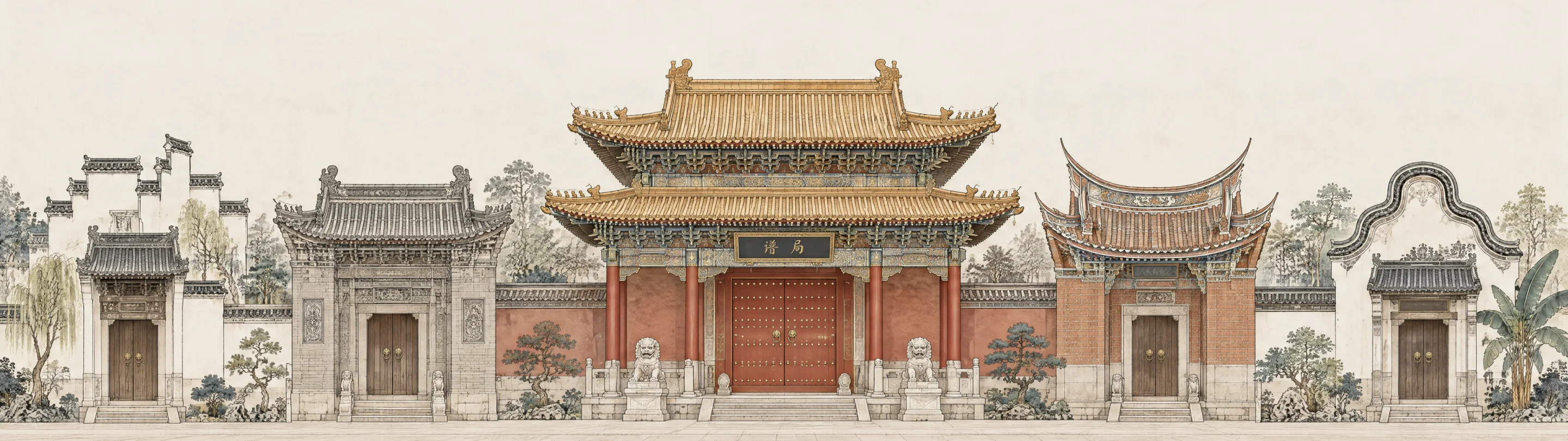
A hundred thousand genealogies; for every assertion, a source.
Evidence in ink Inference in cinnabar
Source values never altered Downgraded, never deleted
The catalogue records and edition histories of 100,000 genealogies; their persons, kinship, migrations and lineage branches; the transmission between genealogies, place names old and new, and era dating across the dynasties are cross-referenced with thirty-three external sources and built into a data foundation that annotates every entry with its source, method, confidence and licence.
The PUJU Genealogy Data Foundation is an independent data product with its own versioning, licensing and data contract; the new PUJU and all subsequent applications are built upon it.
Scale
The who, what, where and when of 100,000 genealogies, in one database.
106,233
genealogies
1,435,277 catalogue-record assertions, ranked preferred, concurrent or deprecated; downgraded, never deleted
376,542
individuals in the genealogies
Aligned from 745,943 mentions across four sources: rule-based extraction, an LLM, Source A and Source B
292,706
events
Of these, 266,084 are migrations; the rest are branch formations, official appointments and imperial examinations
9,487
lineage branches
Formed by cross-genealogy lineage consolidation, covering 28,024 genealogies; plus 6,040 common-origin groups
Era names, sexagenary dates and regnal years converted to Julian Day and EDTF
77,473
external links
FamilySearch, Shanghai Library digital images, CBDB, CCCG, Shanghai Library ancient books database, …
88,455,005
RDF quads
SPARQL queries and full-text search; evidence anchored to code-point ranges in the original abstracts, 609,446 anchors in all
Lineage Branches
Kin scattered across genealogies, here restored to their lineage.
28,024 genealogies, each originally a separate work, with no links between them.
Lineages are consolidated across genealogies through a shared person identifier, or through first-migrant ancestors with the same surname and given name, the same place and compatible dates, yielding 9,487 lineage branches across 398 surnames.
Ordered by each branch’s earliest compilation date: only 284 were first compiled in 1950–1979, while every decade since 1990 counts 800 to 1,100.
Each dot is one lineage branch; dot size shows the number of genealogies it holds (2–43)High reliability 2,385Medium 7,086Low 16 (same name and place only; pending manual review)
Lineage branches by surname: Chen 陈 560, Wang 王 506, Li 李 497, Zhang 张 473, Liu 刘 428, Wu 吴 290, Yang 杨 266, Huang 黄 254, Xu 徐 229, Zhou 周 198, Zhu 朱 190, Hu 胡 172, Xie 谢 130, Zhao 赵 122.
Evidence
Evidence in ink, inference in cinnabar, never mixed.
What the source records is marked in ink; what the system infers, in cinnabar. Every extraction is anchored to a code-point range in the original abstract — 609,446 anchors across the database — so that any conclusion can be traced back to the text on which it rests.
Personal namePlace nameDateRevision numberSystem inference
Pukou Wang Genealogy, Mei Branch 《浦口王氏美房谱》, 10 juan · 清光绪十九年(1893) Original abstract of 196 characters from the Shanghai Library genealogy catalogue, transcribed without alteration.
PersonsMentions from four sources, aligned to five individuals
Person
Rules
LLM
Source A
Source B
Boxiang 伯庠progenitor
Present
Present
Present
Present
Boxu 伯序progenitor
Absent
Present
Present
Present
Bofan 伯颿progenitor
Present
Present
Present
Present
Guanpu 官溥first-migrant ancestor
Present
Present
Absent
Present
Xueqi 学琦branch ancestor
Absent
Present
Present
Present
Wang Guanpu (王官溥) · first-migrant ancestor · 9th generation · courtesy name Jingfu (敬父) · sobriquet Yuanyuan (源远) · birth-order name Zaisan (再三)[29, 31)
Identical names within the same genealogy are aligned; where one source misses a person, the other three fill the gap.
MigrationTwo migrations, resolved to contemporaneous administrative units
南宋初自大名府城迁居鄞县燕山[11, 25)
1127/1177~ · Daming Prefecture → Yin County (Southern Song · Liangzhe East Circuit · Mingzhou)
Tan Qixiang’s Historical Atlas of China, vol. 6, pp. 46, 59; same name, same period · present-day Daming, Hebei → present-day Haishu, Ningbo, Zhejiang
元天历间自鄞县燕山移居奉化浦口(今江口镇浦口王村)[48, 73)
1328/1330 · Yin County → Pukou (Yuan · Zhejiang Province · Qingyuan Route · Fenghua Prefecture)
Tan Qixiang’s Historical Atlas of China, vol. 7, p. 27 · present-day Fenghua, Ningbo, Zhejiang
Revision numberThird revision, first compiled in 1826
谱初修于清道光六年,此为三修本[180, 195)
Third revision of this genealogy · first compiled 1826 · this edition compiled 1893 (catalogue record)
Structure
Five layers, one unbroken thread.
Every conclusion can be traced to the evidence it rests on, the program that produced it and the version of its source. Source values are never altered, additions form a separate layer, and values are downgraded, never deleted.
L4Release10 categories, 254,583 files, 1.68 GB; manifest with per-file sha256
L3ConclusionsAlignment, lineage consolidation, place names, dating and external links, each with confidence and licence
L2Catalogue records and extraction1,435,277 catalogue-record assertions; 745,943 mentions
L1Source textAbstracts and titles preserved verbatim, located by code point
L0Source snapshots and registrationTwo Shanghai Library snapshots, 33 external sources and 27 programs, all registered with sha256
Every value in the catalogue records, persons, places and dates carries its source, the time it was recorded and the method by which it was obtained. Values from multiple sources are kept side by side and ranked in three tiers: preferred, concurrent and deprecated. Values are downgraded, never deleted, and every version remains retrievable.
Preferred
The value presented publicly, labelled with its source and method.
Concurrent
Other sources and variant forms, preserved as found and viewable side by side.
Deprecated
Values withdrawn after correction: downgraded, retained and retrievable at any time.
Pukou Wang Genealogy, Mei Branch 《浦口王氏美房谱》 · Date of compilationPreferred
清光绪十九年(1893)
Source
Shanghai Library genealogy catalogue
Method
Direct field extraction
Recorded
2026-10-29 · pj-v3-alpha
Dating
1893 · EDTF
Licence
CC BY-NC-SA 4.0
Identifier
w3id.org/puju/work/8gsq767eiktniwxs
1,435,277catalogue-record assertions, each recorded with its source, method, time of recording and licence; source values are never altered, and additions form a separate layer.
Continuations
Eighty years, five continuations.
Yiwu Huanxi Wang Lineage Genealogy, Revised Edition 《义乌环溪王氏重修宗谱》: the first-migrant ancestor Rujian (如建) moved from Dongyang to Huanxi in Yiwu during the Zhiyuan era of the Yuan (元至元间). Most editions recorded in the catalogue survive only in part; linked through continuation relations, they reveal the full history of the genealogy’s compilation. Genealogies are shown in ink and relations in cinnabar: relations are inferred by the system, each labelled with its confidence.
181210th revision清嘉庆十七年Extant juan 1, 2, 4, 6, 16, 21
183011th revision清道光十年Extant juan 10, 17
185112th revision清咸丰元年Extant juan 23, 25, 29, 32
187113th revision清同治十年Extant juan 4, 6, 8, 9, 11, 12, 15 and others, 11 in all
189114th revision清光绪十七年Extant juan 5, 8, 11, 12, 14 and others, 10 in all
1911Recompilation清宣统三年Two catalogue records; extant juan 7–10 and others
1931Continuation民国二十年Enlarged revision of the 宣统三年 (1911) edition
For illustration: the seven volumes are generated by an image model; the title slips show titles and revision numbers overlaid by this page from the catalogue records.
6,647ContinuationAfter review, 562 doubtful relations were lowered to “low” confidence: downgraded, never deleted
2,704Same editionIdentical title proper, statement of responsibility, date of compilation and edition
994SubordinateBranch and sub-branch genealogies subordinate to comprehensive or lineage genealogies
284DerivativePhotocopies, facsimiles and reprints of earlier editions
Time & Place
Place names shift across the centuries; dating systems coexist.
Wuyuan: from county to prefecture, and back
The database holds 237 genealogies whose registered place of origin is Wuyuan. Migration destinations are assigned, by the year of the event, to the contemporaneous administrative unit, together with its chain of jurisdiction (per CHGIS V6, cited at record level).
Unit
WuyuanWuyuanPref.Wuyuan
Parent
ShezhouHuizhouRouteHuizhou Prefecture
80010001200140016001800
Raised to Wuyuan Prefecture from 1295 to 1367, under Huizhou Route and, from 1357, under Xing’an Prefecture; today Wuyuan County, Shangrao, Jiangxi Province.
21,419 places
95.0% place-resolution rate for migration endpoints 267,891 of 282,125 resolved
4,655 rows of administrative history for registered places of origin
Era dating: converted to Julian Day and EDTF
Era names, sexagenary dates and regnal years are converted with the DILA month tables, and Gregorian dates use the proleptic Gregorian calendar throughout. Era names and sexagenary dates are checked against each other; where the source says only “南宋初” (early Southern Song), only a range is given.
Dynasty level 181,575Era level 71,936Year level 138,166Month-day level, century level and undetermined 1,978
Each of the 393,655 time spans states its precision: most can be fixed only to a dynasty or an era, just 35 to the exact day, and no greater precision is forced.
Sources & Methods
Many sources, corroborated within one method.
With the Shanghai Library genealogy catalogue as its base text, the foundation draws together thirty-three external sources spanning bibliography, prosopography, historical geography, chronology, local gazetteers and social history. Under a unified ontology and provenance model, heterogeneous materials undergo entity disambiguation, spatio-temporal normalization and cross-source corroboration: not a simple merging of sources, but systematic evidential research.
Copyright in the genealogy data belongs to Shanghai Library; rights in data from other sources remain with their respective holders.
目Bibliography & Textual Criticism目录学与版本学
Titles, registered places of origin, compilation and editions are collated across catalogues, and the continuation, same-edition, subordinate and derivative relations among 100,000 genealogies are modelled as relations between works and expressions.
人Prosopography人物志
Entity disambiguation for mentions from multiple sources: namesakes are distinguished by period, native place and status, then cross-checked against biographical databases of historical figures and consolidated into lineages across genealogies.
地Historical GIS历史地理
Temporal resolution of place names: the contemporaneous administrative unit and its chain of jurisdiction are traced from the year of each event and checked against historical atlases for the same name in the same period.
时Chronology年代学
Era names, sexagenary dates and regnal years are converted to Julian Day and EDTF with calendrical tables, cross-verified through the sexagenary cycle, with the precision of every entry stated.
志Gazetteers & Social History方志与社会史
Migrations are set against the dialect, population and political circumstances of the same time and place: associations are established, causation is never inferred.
网Knowledge Organization知识组织
Assertion-level provenance is modelled with CIDOC CRM, CRMinf, LRMoo and PROV; mappings express “correspondence” in SSSOM, never asserting identity through owl:sameAs.
Methodology
Assertion-level provenance断言级溯源Every conclusion points back to the code points of its source text, the method used and the source version.
Evidence / inference separation证据与推断分层“What is recorded” and “what is inferred” are modelled in separate layers; inference never passes for historical fact.
Reproducible build可复现构建Every source and program is registered with a checksum, and the entire database can be rebuilt in a single run.
External calibration外部校准Independent scholarly datasets serve as the yardstick: blind evaluation, not self-certification.
Privacy
Recent generations stay behind this gate.
今Recent kin not made public
Lineage members recorded in recently compiled genealogies, who may still be living, are excluded from the public data; progenitors, first-migrant ancestors and other forebears appear as usual.
书Compilers as bibliography only
Compilers appear only as bibliographic information and are never aggregated into personal profiles; for recent genealogies, their names are withheld even from the bibliographic record.
县Locations to county level only
Public coordinates go no finer than the present-day county. All rules are applied uniformly before release, so that the website, the open data and every interface follow the same policy.
Openness
Openly accessible, properly citable.
Ten open formats and a complete suite of international standards — dataset description, cultural heritage ontologies, annotation and provenance, time and place, mapping and linking — organized according to established digital humanities practice, so that libraries, researchers and machines share one language.
Parquet
23tables
23 MB, queryable directly in the browser with DuckDB-WASM
HDT · core
9.02million triples
Conclusions, lineage branches, persons, place names and external links; 90 MB
HDT · times
8.39million triples
Dating in a separate package, CC BY-SA 3.0
JSON-LD
106,233documents
One per genealogy, with persons, kinship, events and external links
/id/
135,509resources
JSON-LD for machines, web pages for readers
Linked Places
20,875places
Names, date ranges and chains of jurisdiction; coordinates to present-day county
SSSOM
147,064mappings
closeMatch / exactMatch only, never owl:sameAs
nanopub
88,046entries
Provenance and publication details for each assertion
GEDCOM
179,023individuals
11,414 families, 84,116 sources
App data packages
118,946files
JSON per genealogy and per lineage branch, plus search shards with 571,905 entries
Datasets, distributions, versions and licences all carry machine-readable descriptions, ready to be harvested directly by data catalogues and search engines.
Cultural heritage ontologies文化遗产本体
CIDOC CRM 7.1.3CRMinfLRMooSKOS
Events, persons and places are modelled in CIDOC CRM; inferences are recorded in CRMinf as “beliefs and their grounds”; the works, expressions and edition lineages of the genealogies are expressed in LRMoo.
Annotation & provenance标注与出处
W3C Web AnnotationPROV-ONanopublications
Evidence is anchored to the source text by code-point ranges; every assertion records its source, method and version, and can be cited and verified independently.
Time & place时间与空间
EDTFJulian DayLinked Places FormatCHGIS · TGAZ
Uncertain and interval dates are expressed in EDTF; places carry their historical names, date ranges and chains of parent units, interoperable with international historical gazetteers.
Mapping & linking对照与关联
SSSOMWikidataCBDBIIIF
Cross-database mappings record their basis and confidence in SSSOM, using only closeMatch and exactMatch; images link to the originals through IIIF.
Exchange formats交换格式
JSON-LDRDF N-QuadsHDTApache ParquetGEDCOM 7.0
The same data can be loaded into triple stores, browsers and data-analysis tools, or imported into genealogy software.
Persistent identifiersTechnically ready
Following the w3id persistent identifier scheme, citable addresses and resolution rules are designed for every genealogy, every individual in a genealogy and every place: JSON-LD for machines, web pages for readers.
https://w3id.org/puju/work/{work-id}
AI-Ready
Queryable by AI, traceable to source.
Through a read-only MCP server, a Skill package and an OpenAPI interface, leading AI assistants in China and abroad can query the data directly; their answers keep source evidence and system inference apart and carry persistent identifiers.Interfaces open with the official release
MCPRead-only server: search, genealogy retrieval, place-name resolution, date conversion and citation generation
SkillSkill package: a single SKILL.md that works across AI platforms
OpenAPIOpen interface: people and AI share the same data
Quality
Quality disclosed, limitations stated.
All checks below were performed by models, including blind review by independent model reviewers, to find errors and estimate their magnitude. The results are not a human gold standard and are not presented as human-verified accuracy.
LLM extraction · person precision50 passages, 601 items sampled; three reviewers99.6%
Person alignment · 300 pairs sampledAll judged to be the same person; 95% CI 98.7–100300/300
Place names · county level, high confidence110 of the 600 endpoints in blind review91.8%
Continuation relations · precision at “medium” confidence200 sampled; 95% CI 74.7–86.081.0%
Place names · strict accuracy of resolved endpointsBlind review of 600 endpoints, weighted; 95% CI 70.1–76.673.3%
Place names · prefecture levelThe weakest link; 12.5%–50% by confidence tier≤50%
0255075100
Extracted assertions lacking evidence0Inverted code-point selectors0References to undeclared sources or programs0Kinship codes outside the vocabulary0Unregistered named graphs0owl:sameAs0
Cinnabar points mark the areas still to be strengthened. For the prefecture level, the point shows the high-confidence tier (40%) and the interval spans all three tiers. Every sample, score and item-level justification is archived with the database.
Independent genealogy data infrastructure
The new PUJU is built on the PUJU Genealogy Data Foundation.